|
|


|
Camponotus modoc foraging 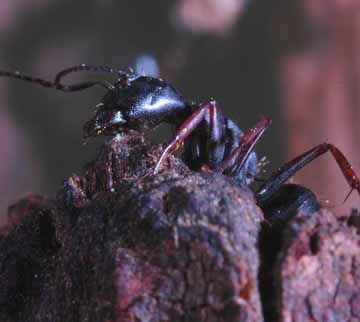 |
Few biological groups are as common in so many habitats as ants. From a rainforest canopy in Brazil to a downtown street corner in Canada only a moment of observation is likely to be necessary before finding an ant. But what does this abundance mean?
To a biologist, abundance is synonymous with biomass. In turn biomass is a measure of energy. By examining the distribution and movement of energy we can begin to understand important features and functions of an ecosystem.
The biology of ants has attracted a great deal of attention in the tropics where ants are the single greatest contributors (just less than 20%) toward total animal biomass. This is more than twice that of total vertebrate biomass. Estimates of ant biomass in other habitats vary greatly but common temperate forest estimates suggest a dry mass biomass of around 40 kg ha-1. Compare this to moderate moose biomass in the central interior of British Columbia where wet mass values of approximately 4 kg ha-1 are common.
Despite the ubiquity of ants in boreal and sub-boreal forests we know very little about them. This webpage, hopes to provide some information relating to ant research in British Columbia and, with time, provide a key to the identification of many ant species.
All images by R. Higgins unless otherwise noted
Publications
The European fire ant pages
The
Argentine ant
Ants of
British Columbia: Species List (pdf)
Ants and Pitfall Traps
The Doronomyrmex pocahontas enigma
Wildlife and scenery in central British
Columbia
Ants of
the Central Interior of British Columbia: Dr. Staffan
Lindgren, UNBC
Ants
and Carabid Beetles: Duncan McColl
|
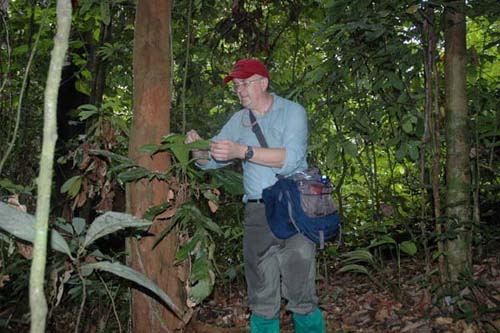
Borneo, August 2010 |
Dr. Robert J. Higgins
Department of Biological Sciences
Thompson Rivers University
805 University Way
Kamloops, BC
V2C 0C8
Canada
E-Mail: rhiggins@tru.ca |